<?xml version="1.0" encoding="utf-8"?><feed xmlns="http://www.w3.org/2005/Atom" ><generator uri="https://jekyllrb.com/" version="3.10.0">Jekyll</generator><link href="http://www.kylegiddon.com/feed.xml" rel="self" type="application/atom+xml" /><link href="http://www.kylegiddon.com/" rel="alternate" type="text/html" /><updated>2026-03-12T22:06:16+00:00</updated><id>http://www.kylegiddon.com/feed.xml</id><title type="html">Kyle Giddon</title><subtitle>Product Analytics and More</subtitle><entry><title type="html">Catalog of the 21st-century layer</title><link href="http://www.kylegiddon.com/catalog-twenty-first-century/" rel="alternate" type="text/html" title="Catalog of the 21st-century layer" /><published>2026-03-12T00:00:00+00:00</published><updated>2026-03-12T00:00:00+00:00</updated><id>http://www.kylegiddon.com/catalog-twenty-first-century</id><content type="html" xml:base="http://www.kylegiddon.com/catalog-twenty-first-century/"><![CDATA[<p>Archaeological recovery from the early twenty-first-century North American layer has produced a dense field of small, emotionally significant objects. The following catalog summarizes current scholarly interpretations:</p>

<p><strong>Large Insulated Vessel (“Stanley Cup”)</strong>: This oversized, personalized drinking container appears to have been carried continuously, even when empty, suggesting ritualized hydration practices combined with status display. Though sharing a name with a major trophy awarded in a ceremonial combat sport, the portable version seems to have conferred honor primarily through color coordination and sticker adornment rather than martial prowess.</p>

<p><strong>Yoga Mat</strong>: A portable ritual carpet linked to training by members of a warrior class. Textual evidence supports this view, though a competing interpretation attributes primary usage to dogs.</p>

<p><strong>Child’s Doll</strong>: The large-eyed, fur-covered idol deemed “Labubu” served as a votive comfort object linked to petitionary rites involving display and acquisition. Surviving specimens are frequently preserved in original packaging, indicating that devotion increased with non-contact. The form continues a long lineage of emotional effigies, extending backward through earlier charm figures (“Furby”) and boxed animal-gods (“Beanie Baby”) to a more primitive sacred object consisting of an ordinary “pet” stone.</p>

<p><strong>Portrait Rod</strong>: A telescoping camera mount for self-recording, typically clamped to a handheld communication device and extended outward from the operator. Its prevalence indicates unresolved focal-length constraints in twenty-first-century consumer optics.</p>

<p><strong>Metal Straw</strong>: A durable drinking tube transported separately from its vessel. Its reason for manufacture remains unclear, as radiocarbon dating shows that earlier plastic tubes were already durable enough to survive into the present layer.</p>

<p><strong>Cable Drawer (Knotted Wires of Unknown Purpose)</strong>: Domestic cord nests containing obsolete connectors to vanished machines. They were carefully retained despite clear incompatibilities. Close examination reveals that the cords are of different vintages, implying they were never meant to mutually connect. Their relationship to one another remains the subject of active scholarly dispute.</p>

<p><strong>License Plate Cover</strong>: These fitted semi-transparent casings appear to have been installed to preserve the integrity of the owner’s civic identification marker, indicating a widespread concern for the proper maintenance of official records.</p>

<p><strong>Internet Router</strong>: A blinking signal totem that mediated access to the invisible information field. Its workings were rarely understood, but faith in a ritual involving temporary disconnection and solemn waiting was widespread. This rite is among the best-documented religious ceremonies of the period.</p>

<p><strong>Robotic Vacuum</strong>: A circular domestic labor automaton assigned to floor maintenance. Despite limited competence, it was granted continuous employment and a personal name. Most scholars classify these units as early precursors to generalized machine labor.</p>

<p><strong>Foam Roller</strong>: A cylindrical compression device used in domestic settings. Its form strongly resembles earlier road-compaction machinery, suggesting a scaled-down household derivative. No infrastructure work has been attributed to its use.</p>

<p><strong>Weighted Textile Covering</strong>: A high-mass example from the continuous textile tradition extending back to the earliest surviving artifacts. Analysis of wear patterns indicates voluntary use, including specimens with added internal weighting. Restraint classification has been largely abandoned.</p>

<p><strong>Candle in Glass Housing</strong>: An open-flame lighting device that persisted long after safer illumination technologies were widely available. Late-period specimens are frequently associated with “scent houses” such as Le Labo, suggesting guild protection of the technology. Light output appears to have been secondary to atmospheric objectives.</p>

<p><strong>Universal Electronic Remote</strong>: A multi-system electronic command artifact with a densely populated symbolic interface. Only a small subset of controls show consistent wear, though the remaining symbols are rendered with equal prominence. While classified as “universal” at the time of use, effective authority appears to have been partial and situational.</p>

<p><strong>Wireless Ear Unit</strong>: A small white insertable device shaped to lock into a single ear, with no visible fasteners or external wiring. Surface wear suggests prolonged bodily contact. Though clearly manufactured in bilateral sets, recovery is overwhelmingly singular. Communication function has been proposed but not demonstrated.</p>

<p><strong>Unknown Object</strong>: A molded perforated foam shell with forward taper, pivoting rear strap, and treaded base. Specimens measure under ten inches in length and frequently exhibit high-saturation coloration. Wear patterns indicate regular ground contact. The footwear hypothesis has been formally rejected due to excessive ventilation and fluid ingress risk. It is currently cataloged under drainage equipment.</p>

<p>Further excavation is expected to clarify the functions of these objects, and additional funding has been requested.</p>]]></content><author><name></name></author><summary type="html"><![CDATA[Archaeological recovery from the early twenty-first-century North American layer has produced a dense field of small, emotionally significant objects. The following catalog summarizes current scholarly interpretations:]]></summary></entry><entry><title type="html">Kinski agonistes</title><link href="http://www.kylegiddon.com/cobra-verde/" rel="alternate" type="text/html" title="Kinski agonistes" /><published>2026-02-13T00:00:00+00:00</published><updated>2026-02-13T00:00:00+00:00</updated><id>http://www.kylegiddon.com/cobra-verde</id><content type="html" xml:base="http://www.kylegiddon.com/cobra-verde/"><![CDATA[<p><em>A review of the 1987 film <strong>Cobra Verde</strong>. Currently <a href="https://www.criterionchannel.com/videos/cobra-verde">streaming on the Criterion Channel</a> for the curious.</em></p>

<p>Herzog–Kinski gets a photocopy: recognizable, but lighter, blurrier. Toner running low.</p>

<p>Herzog has never been a first-rate formalist, nor seemingly interested in becoming one. But the earlier Kinski collaborations had a heavier narrative spine, enough to bear the strain of both Herzog’s excesses and elisions. <em>Aguirre</em> gave us a clean line of descent into colonial delirium (one way down, no off-ramps). <em>Fitzcarraldo</em> approached something like classical design: a dream, the means, an obstacle, yadda yadda. With those vertebrae in place, Herzog could roam freely— toward the striking setpieces (the jungle march, the boat over the mountain); the mass-scale choreography; the barbed images of empire and folly; and, naturally, toward Kinski’s deranged ferocity. What a face! What dangerous, animal grace! For actors who act with their whole body, he and Toshiro Mifune are standing comfortably on the podium.</p>

<p>In <em>Cobra</em>, the spectacle remains, as does Kinski’s fury (perhaps never more feral), but the spine has gone missing. Paging an orthopedist. The movie lurches, too fast and then too slow. We meet Kinski’s character in Brazil as a laborer, then a bandit, then a slave overseer, then an agent of the Portuguese state, all in about twenty minutes. Later in Africa, factions appear and dissolve, loyalties shift, events accumulate—but they don’t lock together. If only all failures were this interesting.</p>

<p>The high points come without Kinski, when the film slips into a semi-documentary mode: the camera sitting back to observe ritual, movement, and social choreography without trying to hammer them into plot. But then the movie doesn’t conclude so much as give up the effort. Like this.</p>]]></content><author><name></name></author><summary type="html"><![CDATA[A review of the 1987 film Cobra Verde. Currently streaming on the Criterion Channel for the curious.]]></summary></entry><entry><title type="html">Stress fractures</title><link href="http://www.kylegiddon.com/browning-variation/" rel="alternate" type="text/html" title="Stress fractures" /><published>2026-02-10T00:00:00+00:00</published><updated>2026-02-10T00:00:00+00:00</updated><id>http://www.kylegiddon.com/browning-variation</id><content type="html" xml:base="http://www.kylegiddon.com/browning-variation/"><![CDATA[<p><em>A review of the 1951 film <strong>The Browning Version</strong>. No plot recap; some familiarity assumed. It is <a href="https://www.criterionchannel.com/videos/the-browning-version">streaming on the Criterion Channel</a> for the curious.</em></p>

<p>Civil engineers check for structural stress; critics must check for structurally induced pathos. Too much of it means the building’s liable to buckle.</p>

<p>Terence Rattigan’s play, transferred nearly intact to film, might work better under the proscenium arch, but on screen it comes across as overly engineered. Michael Redgrave’s Crocker-Harris can do next to nothing against his antagonists (his school, his marriage, his health), which turns him into an experiment subject, a dose-response test. Under pressure, he squirms and learns. We watch. The structural beats are so tight that the emotions land basically by chemistry—reaction guaranteed. Drama earns its emotion when plot is driven by character: the converse, as here, is rarely a sign of health.</p>

<p>Crocker-Harris’s psychological turns recall another tragic figure: King Lear. No less. Both grapple with the delayed recognition of a catastrophic mistake, revelation under pressure, and the too-late attempt at repentance. And the same charge of structural coercion can be leveled at both plays: I’ve always found <em>Lear</em> weakest when psychological acuity gets sacrificed to the maw of the plot (think Lear’s Act I detonations; Gloucester’s credulity about his son’s betrayal—something I certainly struggled with when I played Gloucester in a high school production). But <em>Lear</em> escapes (or rather rises above) the charge because of its overwhelming force: its tragic scale, its mounting dread…</p>

<blockquote>
  <p><strong>KENT:</strong> Is this the promised end?<br />
<strong>EDGAR:</strong> Or image of that horror?</p>
</blockquote>

<p>Bodies pile up. The stage picture turns apocalyptic. The dramatic effect is undeniable. Indeed, Shakespeare critic A.C. Bradley described Lear as “Shakespeare’s greatest achievement, but it seems to me not his best play.”</p>

<p>Rattigan, by contrast, has no such shield. As a chamber character study, <em>Browning</em> is subtler by design. The psychology often rings truer than Lear’s (for Crocker-Harris, at least—his henpecking wife is unfortunately drawn in coarser chalk); and the film’s best moments come from, again like Lear, his lamentations over his mistake. The standout scene is in Crocker-Harris’s classroom, where he reflects on his career with the teacher who’s replacing him: “I realize I did not possess the knack for making myself liked. But at the beginning at least I did try very hard to communicate to the boys, those boys sitting out there, some of my own joy in the great literature of the past.” He failed, and now for years has no longer tried. Redgrave gives a virtuoso performance and is able to get across the full rainbow of emotion in the very repressed, strictured range of expression that his character permits. The close-ups certainly help—score a point for the screen over the stage.</p>

<p>But oof, that ending. The concluding speech to the student body is a misfire, not least because of the implausible burst of spontaneous applause that greets it. It’s the opposite mistake from before: now everything bows to cinematic payoff and the demand for a big concluding moment. Why, oh why, must Crocker-Harris’s redemption be in public? It has neither theatrical nor narrative logic. He has no Cordelia from whom to beg forgiveness. His students and colleagues wouldn’t care what he thinks of himself—it’s already shown he’s seen as little more than a dinosaur, to be buried among his Greek and Latin books. Doesn’t it undercut the tragic finality by having some external recognition of his own new insight? Is it not the more fitting for this lonely, self-repressed character to have no one with whom to share his final eureka?</p>]]></content><author><name></name></author><summary type="html"><![CDATA[A review of the 1951 film The Browning Version. No plot recap; some familiarity assumed. It is streaming on the Criterion Channel for the curious.]]></summary></entry><entry><title type="html">Return to Lord Weary’s Castle</title><link href="http://www.kylegiddon.com/robert-lowell-a-return/" rel="alternate" type="text/html" title="Return to Lord Weary’s Castle" /><published>2025-07-05T00:00:00+00:00</published><updated>2025-07-05T00:00:00+00:00</updated><id>http://www.kylegiddon.com/robert-lowell-a-return</id><content type="html" xml:base="http://www.kylegiddon.com/robert-lowell-a-return/"><![CDATA[<p>At eighteen years old, stupid both intellectually and emotionally but curious about making improvements, I began my undergraduate education and enrolled in an introductory course on writing poetry.</p>

<p>The Book of Genesis tell us that on the first day of Creation, God separated the light from the darkness. And indeed on day one of class, our professor Paul Breslin drew his own boundary and told us we’d be restricted to writing in meter. Some sighs could be heard in the seminar room and not a few faces darkened with either fear or disappointment, but <a href="https://quoteinvestigator.com/2021/05/24/poem-tennis">you can’t learn tennis without a net</a>. So it went. Along with Professor Breslin, a Norton poetry anthology served as our guide to this new underworld: we studied the canon, learned our iambs from our trochees, and I ended up drafting several poems that were highly derivative of the greats and (it goes without saying—but for completeness I must add) not very good.</p>

<p>My most significant influence turned out to be Robert Lowell (1917–1977). I don’t remember how exactly I found a  gateway into his vast and (at times impenetrable) corpus, but soon enough I was taking lessons from the <a href="https://www.poetryfoundation.org/poems/48984/the-quaker-graveyard-in-nantucket"><em>The Quaker Graveyard in Nantucket</em></a> (which still hits like a sledgehammer); the flickering succession of images and memories in <a href="https://www.blueridgejournal.com/poems/rl-wakin.htm"><em>Waking Early Sunday Morning</em></a>; and the elegaic mirror <a href="https://www.poetryfoundation.org/poems/57035/for-the-union-dead"><em>For the Union Dead</em></a>. The influence came through strongly enough that  Professor Breslin, a Lowell expert, told me, “I see you’ve been reading Robert Lowell. In fact I even know what book you’ve been reading.” (He was right.) I for one was glad the influence was visible through the dark, obscuring glass of a freshman student’s “experiments.” Professor Breslin was complimentary, noting that young artists often begin as imitators before they find their own voice. And Lowell’s was a difficult style to replicate: muscular diction, heavy enjambment, and a unification of the personal and historical, the private and public.</p>

<p>I would share the poems but between apparently incomplete computer file migrations and the unknown whereabouts of any extant paper copies, the poems  seem to have been lost—(yes, it is funny to use that word <em>lost</em>, as if we are talking about the missing fragments of Sappho and not the juvenalia of a teenager). All I remember are stray pieces, chips, and flecks, such as a line referring metaphorically to “a chessman shifted to a safer square,” which I know I only remember because Professor Breslin (gently) suggested that the metaphor was insufficiently foreshadowed and unrelated to the rest of the poem. Yes, Professor, <a href="https://quoteinvestigator.com/2025/02/20/axe-forgets/">the axe forgets, but the tree remembers</a>. Just kidding. You will notice, however, that the line <em>is</em> in correct iambic pentameter.</p>

<p>During the class, I raided the library stacks and hoarded Lowell’s books, among them his debut <em>Lord Weary’s Castle</em> (1947), <em>Life Studies</em> (1959), and the crazily ambitious but uneven <em>History</em> (1973), which takes as its subject . . . all of history, unrhymed sonnet by unrhymed sonnet. These were my preceptors. Soon enough though, other classes had other demands; and the books were remanded to their dusty stacks.</p>

<p>Fourteen years later, I am  now, as I endeavored, smarter—a better friend, son, partner, and citizen—but, alas, the piston-like metabolism of the undergraduate has since become gummed up. Until recently I had barely revisited Lowell—excepting when I moved to Boston after graduation and finally saw with my own eyes “St. Gauden’s shaking Civil War relief,” the monument to the Massachusetts 54th Regiment that Lowell describes in <a href="https://www.poetryfoundation.org/poems/57035/for-the-union-dead"><em>For the Union Dead</em></a>. He writes:</p>

<blockquote>
  <p>Their monument sticks like a fishbone<br />
in the city’s throat.<br />
Its Colonel is as lean<br />
as a compass-needle.</p>
</blockquote>

<blockquote>
  <p>He has an angry wrenlike vigilance,<br />
a greyhound’s gentle tautness;<br />
he seems to wince at pleasure,<br />
and suffocate for privacy.</p>
</blockquote>

<p>The poem, and the monument, remain refreshingly alive—civic, public, still speaking, and by their subject worthy of awe.</p>

<p>A single volume of Lowell’s work, <em>Collected Poems</em>, was released in 2003 and runs to 1,200 pages. Earlier this year I began an assault on the castle. Inside, I found some poems that were dear old friends; others were acquaintances, slipped from memory, that I glad to meet again; but most of them, buried in the hadal trenches of Lowell’s volumes, were new faces.</p>

<p>Indeed, the book was reviewed on its release by none other than A.O. Scott in an <a href="https://slate.com/culture/2003/06/why-read-1200-pages-of-robert-lowell.html">article</a> for <em>Slate</em> whose URL slug is “why-read-1200-pages-of-robert-lowell.html” but otherwise proposes that query only implicitly. 
Scott argues that the whole of Lowell’s poetry is worth reading—and how? “Straight through from beginning to end” despite its many longeuers. I agree. To either read only the best-known poems or to browse haphazardly would mean missing out on the hundreds of felicities in otherwise minor or little-known works, like the astonishing concluding couplet in <a href="https://poets.org/poem/speak-woe-marriage"><em>“To Speak of Woe That Is in Marriage”</em></a>:</p>

<blockquote>
  <p>Gored by the climacteric of his want,<br />
He stalls above me like an elephant.</p>
</blockquote>

<p>This is heady, emotional stuff, only possible by Lowell’s mastery of the formal elements—the juxtaposition of the violent monosyllable of the verb “gored,” followed by the line’s load-bearing noun “climacteric” and its heavy Latinate construction. Yes, “climacteric” may make the reader want to consult a dictionary to make sure we’re getting the full valence of Lowell’s meaning. And you, too, should.</p>

<p>I have less personal interest in debating the <em>meaning</em> of the more esoteric imagery, like another final couplet, this one from <em>Beyond the Alps</em> (1964):</p>

<blockquote>
  <p>Now Paris, our black classic, breaking up<br />
Like killer kings on an Etruscan cup.</p>
</blockquote>

<p>After the release of the <em>Collected Poems</em>, these lines somehow kicked off a <a href="https://www.nybooks.com/articles/2003/09/25/robert-lowell-an-exchange/">furious exchange of letters</a> in the <em>New York Review of Books</em>. Why is Paris a black classic and why is it like the killer Etruscan kings? The debate seems a bit trifling: I tend to think that Lowell’s power comes from his supreme architecture of sounds and images, and that too much interrogation can be both bathetic and demystifying. (It is striking to look back on 2003 and see how much ink was spilled on the two lines <em>in a magazine for the general reading public</em>, and ruefully conclude that this wouldn’t happen in the present era, twenty-two years later . . . that everything now is too besmirched by the political—both by the consuming whirlpool of the Trump Era when it comes to the demands of public intellectualism and also by the sense that close reading and aesthetic considerations have taken an increasing backseat.)</p>

<p>To understand Lowell, Scott <a href="https://slate.com/culture/2003/06/why-read-1200-pages-of-robert-lowell.html">wrote</a>, “his poems rely so formidably on acquaintance with the staggering range of his worldly and personal references.” True, perhaps, but the acquaintance is unnecessary to understand the bulk of Lowell’s thrust. Knowing more about the details of, e.g., Lowell’s failed marriages, alcoholism, or nervous breakdowns will certainly make one know more about Robert Lowell the poet but may not return the investment when it comes to the pleasure of reading the poet’s poems. Educated liberally enough, I will have some familiarity with King David and Bathsheba, the Charles River, and Troy’s Hector, tamer of horses, but don’t care to learn more about Lowell’s Uncle Winslow. Largely, I feel the same way here about Lowell’s references that I do about reading Pynchon’s: when I understand the allusion, I’ll extract some morsel of delight from completing the puzzle and opening myself to all its branching extra-textual connotations; when I don’t understand the reference, I may be intrigued enough to consult an (online) encyclopedia or ask Google, or I might simply move on, unenlightened but no worse for wear. Consulting footnotes during the very act of reading or, God forbid, reading alongside some separate exegetic “guide” full of annotations has never seemed to me like reading at all—more akin to detective work, and, like that, best left to professionals.</p>

<p>After touring through 1,000 pages, what came to mind was the music critic Robert Christgau’s <a href="https://www.robertchristgau.com/get_artist.php?name=bruce+springsteen">gnomic pronouncement about Bruce Springsteen</a> from 1978: “An important minor artist or a rather flawed and inconsistent major one.” (Springsteen turned out to be a major one.) Not all of Lowell’s poems equally reward close reading or re-reading. The hundreds of pages of blank-verse sonnets that took up his later career can be accused of prattling, and some poems, like his assessment of Joseph Stalin(!) have a half-finished quality:</p>

<blockquote>
  <p>The large stomach could chew only success. What raised him<br />
was an unusual lust to break the icon,<br />
joke cruelly, seriously, and be himself.</p>
</blockquote>

<p>He tries to tie the bow too tight, and I think there is too much <em>Lowell</em> in here and not enough Stalin.</p>

<p>But it would be wrong to end on a negative note. Lowell’s best work matches up with anyone’s best. Which is why I find it fitting to have the <em>Collected Poems</em> in quasi-permanent installation on a corner of my desk: there when the moment calls for it to be consulted, and always waiting with a new discovery or surprise. What has happened since then is an act of transfer, from page to memory, because his images have also taken up their own quasi-permanent residence in a sector of my mind.</p>]]></content><author><name></name></author><summary type="html"><![CDATA[At eighteen years old, stupid both intellectually and emotionally but curious about making improvements, I began my undergraduate education and enrolled in an introductory course on writing poetry.]]></summary></entry><entry><title type="html">Who signed the letters of transit in Casablanca? A not-wholly-necessary Bayesian approach</title><link href="http://www.kylegiddon.com/casablanca-letters-of-transit/" rel="alternate" type="text/html" title="Who signed the letters of transit in Casablanca? A not-wholly-necessary Bayesian approach" /><published>2024-02-17T00:00:00+00:00</published><updated>2024-02-17T00:00:00+00:00</updated><id>http://www.kylegiddon.com/casablanca-letters-of-transit</id><content type="html" xml:base="http://www.kylegiddon.com/casablanca-letters-of-transit/"><![CDATA[<p>Last month, I was rewatching the great 1942 film <em>Casablanca</em> (as one does). Early on, the character Ugarte introduces the central <a href="https://en.wikipedia.org/wiki/MacGuffin">MacGuffin</a> of the plot: the “letters of transit” that allow the bearer to move freely through Vichy or occupied territory. Watching with subtitles, I had to pause after this line:</p>

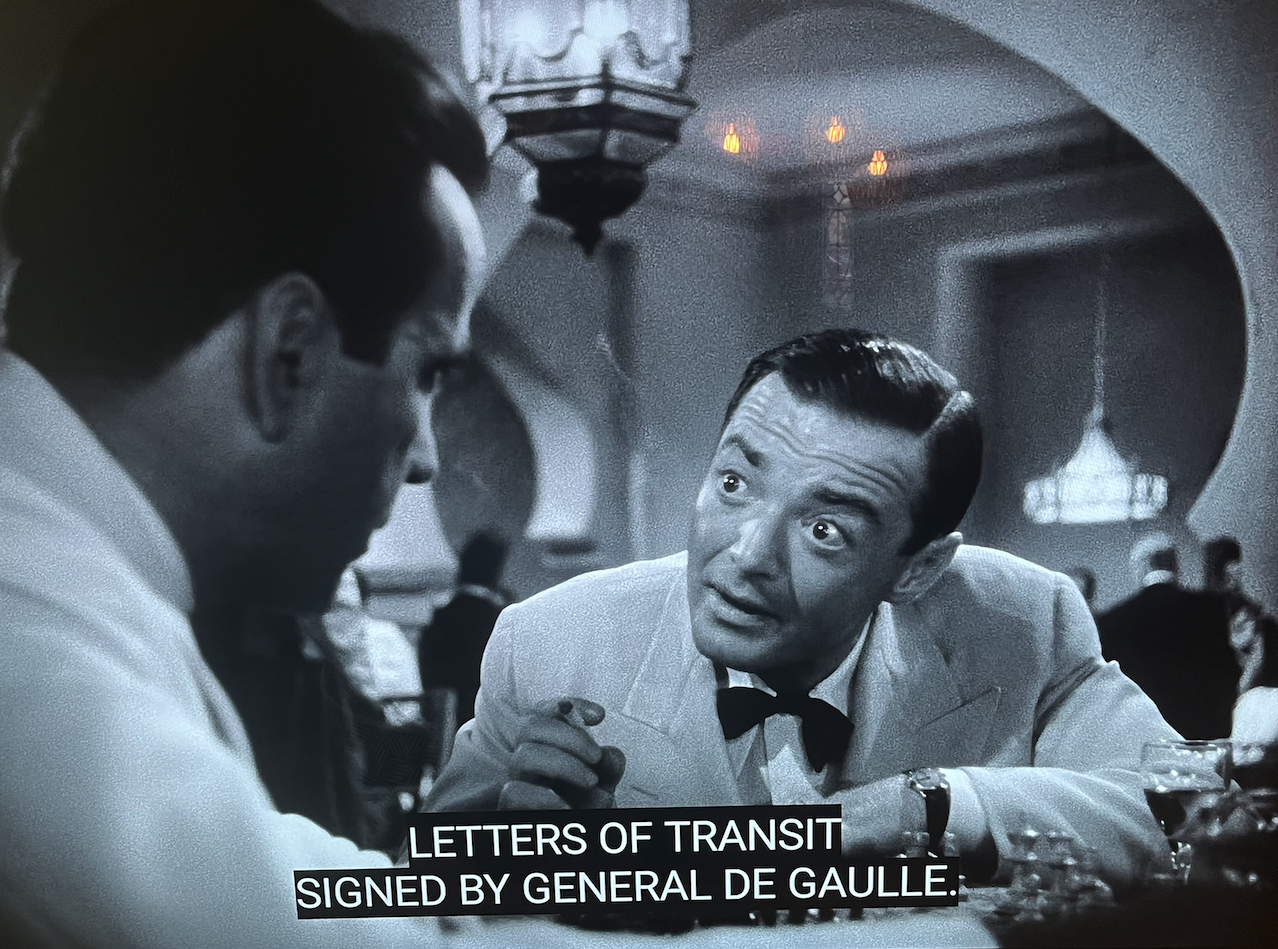
<p><img src="/images/casablanca/letters_of_transit.png" alt="Letters of transit signed by General de Gaulle" /></p>

<p>Letters of transit signed by General de Gaulle? This doesn’t make much sense. Charles de Gaulle was the leader of the Free French forces, and his signature on certain papers would mean nothing in Vichy-controlled French West Africa, where the film is set.</p>

<p>I’m not the first to notice this. This <a href="https://richardlangworth.com/darlan-degaulle-casablanca">convincing blog post by Richard Langworth</a> argues that the subtitle is a mistake, and the line says the letters are signed by General <em>Weygand</em>, not de Gaulle.  <a href="https://en.wikipedia.org/wiki/Maxime_Weygand">Maxime Weygand</a> was the Vichy government’s Delegate-General in French North Africa—which makes perfect sense in the context of the film. (Ugarte is played by the Hungarian-accented Peter Lorre, and it’s not entirely clear whether he says “de Gaulle” or “Weygand” in the original audio.)</p>

<p>We can ask the question in terms of <a href="https://en.wikipedia.org/wiki/Bayesian_inference">Bayesian inference</a>. Given the evidence of the subtitle saying “General de Gaulle”, what is the probability that Ugarte says “de Gaulle” in the actual film?</p>

<p>Let’s define the following terms:</p>

<ul>
  <li>\(P(D)\): The prior probability that Ugarte says “de Gaulle” in the film.</li>
  <li>\(P(S\mid D)\): The probability that the subtitle says “de Gaulle” given that Ugarte says “de Gaulle” in the film.</li>
  <li>\(P(S\mid\neg D)\): The probability that the subtitle says “de Gaulle” given that Ugarte does <em>not</em> say “de Gaulle” in the film.</li>
</ul>

<p>Given this, we want to solve for \(P(D\mid S)\), the probability that Ugarte says “de Gaulle” in the film given that the subtitle says “de Gaulle”.</p>

<p>What values should we assign to these terms?</p>

<p>Because the subtitle clearly says “de Gaulle”, we can assume that \(P(S\mid D) = 1\). That is, if the line is “de Gaulle”, the subtitle will certainly say “de Gaulle”.</p>

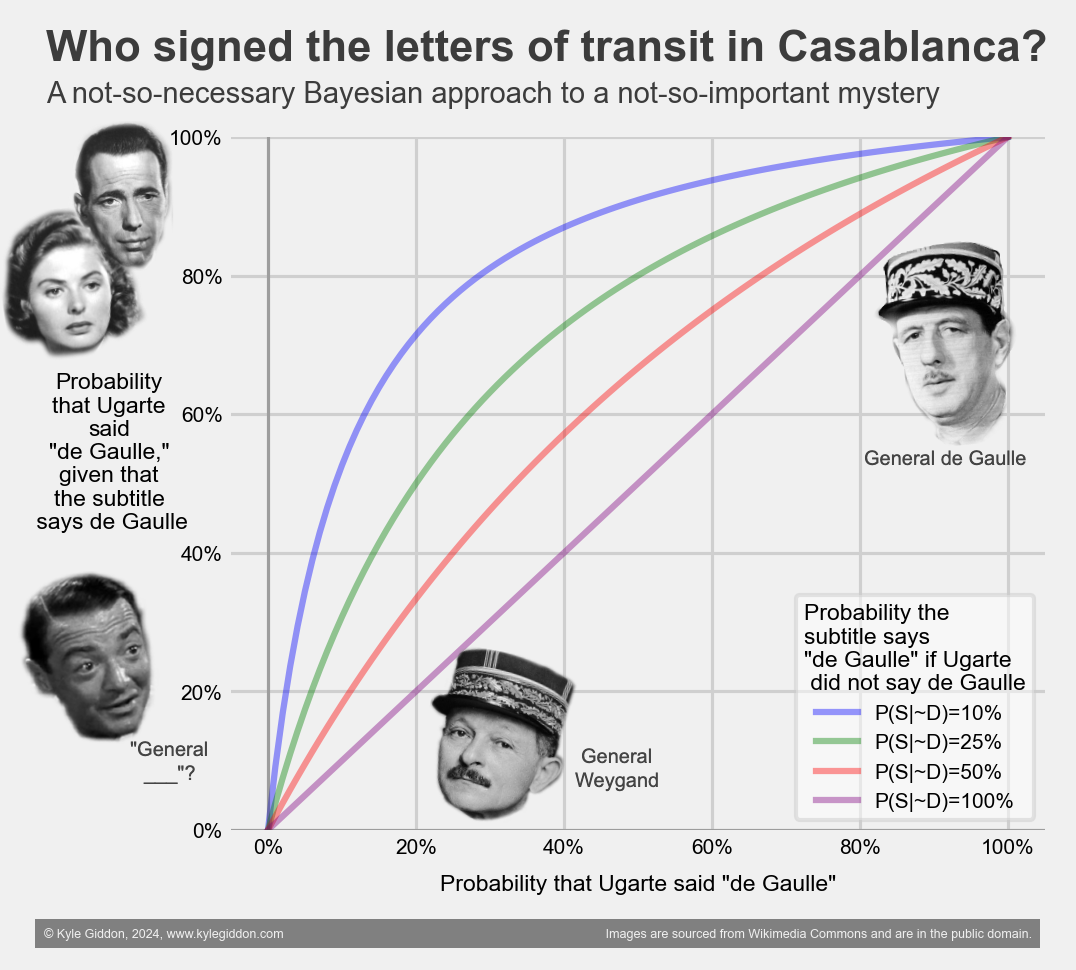
<p>The other probabilities don’t have obvious values. We don’t have the script handy. We’ll make a chart of the possible values of \(P(D)\) and \(P(S\mid\neg D)\), and then solve for \(P(D\mid S)\) depending on these values.</p>

<p>To solve for the probability that Ugarte says “de Gaulle” in the film given that the subtitle says “de Gaulle”, we can use Bayes’ theorem:</p>

\[P(D|S) = \frac{P(S|D)P(D)}{P(S)}\]

<p>We can also write \(P(S)\) in terms of \(D\) and \(\neg D\):</p>

\[P(S) = P(S|D)P(D) + P(S|\neg D)P(\neg D)\]

<p>After doing so, we get the following result (code is available <a href="https://github.com/khgiddon/casablanca-letters-of-transit">here</a>):</p>

<p><img src="/images/casablanca/output_images.png" alt="Letters of transit signed by General de Gaulle" /></p>

<p>Now, what probabilities should we assume for \(P(D)\) and \(P(S\mid\neg D)\)?</p>

<p>I assign high prior probability to Ugarte <em>not</em> saying de Gaulle, because the line does not make sense and there is an alternative (Weygand) that does make make sense. de Gaulle was famous at the time and one thinks it likely that someone on set would have noticed the error. I’d put \(P(D) = 0.05\).</p>

<p>For \(P(S\mid\neg D)\), or the probability that the subtitle says “de Gaulle” given that Ugarte does not say “de Gaulle,” I’d put \(P(S\mid\neg D) = 0.5\). If the subtitle writer was not looking at the script and was not sure what Ugarte said, they might have guessed “de Gaulle” because it’s a much more famous name than Weygand, and may have been unfamiliar with the latter.</p>

<p>Using these inputs gives us \(P(D\mid S) = 0.095\). That is, a 9.5% chance that Ugarte says “de Gaulle” in the film given that the subtitle says “de Gaulle.” Substitute your own assumptions as you see fit!</p>

<p>I’d argue that there’s a much greater historical plot hole in the film—the question of why the Nazi officer Major Strasser does not arrest (or assassinate) Laszlo. Vichy would not be enough to protect him. The “answer” to that one is probably that there would not be nearly so compelling a movie if that were the case. True. All is forgiven.</p>]]></content><author><name></name></author><summary type="html"><![CDATA[Last month, I was rewatching the great 1942 film Casablanca (as one does). Early on, the character Ugarte introduces the central MacGuffin of the plot: the “letters of transit” that allow the bearer to move freely through Vichy or occupied territory. Watching with subtitles, I had to pause after this line:]]></summary></entry><entry><title type="html">A lovely throwaway sentence in Don DeLillo’s “Underworld”</title><link href="http://www.kylegiddon.com/delillo-great-sentence/" rel="alternate" type="text/html" title="A lovely throwaway sentence in Don DeLillo’s “Underworld”" /><published>2024-02-05T00:00:00+00:00</published><updated>2024-02-05T00:00:00+00:00</updated><id>http://www.kylegiddon.com/delillo-great-sentence</id><content type="html" xml:base="http://www.kylegiddon.com/delillo-great-sentence/"><![CDATA[<p>Midway through the journey of Don DeLillo’s novel <em>Underworld</em> (1998), there’s a sentence that, at first glance, seems unremarkable:</p>

<p>“We drove an empty road.”</p>

<p>It’s a one-sentence paragraph that anyone could have written—though it comes immediately after a paragraph of clearly DeLilloesque description that <em>not</em> anyone could have written:</p>

<blockquote>
  <p>The rim clouds took on a chromium edge and the high sky was still an easy noonish blue. But the pit went dark in a hurry, the vast plastic liner wind-lapped and making the eeriest sort of music, just outside the wave-fold of nature, and the surface was indigo now, still faintly sky-streaked, washed by gradations of shade and motion. We stood a moment watching and then went back to the car. Detwiler sat in the middle of the rear seat, needling us about dumping our garbage on sacred Indian Land. And about Whiz Co’s vanguard status. He thought the firm had the hard-core appetites of any traditional company.</p>

  <p>We drove an empty road.</p>

  <p>“You tracking the rumors, Sims? This ship you’ve got.”</p>

  <p>“It’s not my area.” […]</p>
</blockquote>

<p>I am always hesitant to overexplain the aesthetics of literature—to try to reduce its music and mystery to a test-tube formula—but this sentence warrants some additional schematizing.</p>

<p>The first remarkable thing about the sentence is that, strictly speaking, it is not grammatically correct.</p>

<p>“Drove” is of course the irregular past tense of “drive.” “Drive” has several meanings, among them (per the <em>New Oxford American Dictionary</em>):</p>

<ol>
  <li>To operate and control the direction and speed of a motor vehicle. <em>[no object, usually with adverbial of direction]</em></li>
  <li>To propel or carry along by force in a specified direction. <em>[with object and adverbial of direction]</em></li>
  <li>Urge or force (animals or people) to move in a specific direction <em>[with object and adverbial of direction]</em></li>
  <li>(Of a source of power) provide the energy to set and keep (an engine or piece of machinery) in motion.</li>
  <li>(Of a factor feeling) compel (someone) to act in a particular way; especially one that is considered desirable or inappropriate.  <em>[with object]</em></li>
</ol>

<p>(And some others derivative of these definitions. . . )</p>

<p>DeLillo’s usage corresponds to definition #1, but he uses “drove” as a transitive verb (having an object), where the object of the verb is “an empty road,” and with no adverbial of direction. A grammatically correct sentence might say: “We drove <em>down</em> an empty road,” or “We drove <em>on</em> an empty road.” But “an empty road” does not make sense as the direct object of “drove”: the car is being driven, not the road.</p>

<p>But any of these grammatically correct sentences would have been lesser. DeLillo’s sentence is musical and lyrical; it trusts its reader to deduce the meaning. More formally, I think the sentence works better than its alternatives because of its prosody: the sentence is composed of six syllables, grouped into three perfect iambs:</p>

<blockquote>
  <p>We <u>drove</u> / an <u>emp-</u> / -ty <u>road</u>.</p>
</blockquote>

<p>Why does it sound so good? There’s something sonic and psychological about the effect of the prose rhythm. In her book <em>Poetic Closure: A Study of How Poems End</em> (1992), Barbara Herrnstein Smith writes that “Metric regularity, especially when accompanied by monosyllabic diction, has closural effects . . . it has an expressive effect that enhances closure and authority . . . it suggests control, authority, […] dependability, [and] a slowing down of pace.”</p>

<p>The one-sentence paragraph closes the paragraph that precedes it and transitions to the dialogue that follows. The expressive adjective “empty” works together with the three iambs to create a sensation of slow movement and isolation.</p>

<p>How conscious was DeLillo of the formal metrical elements? DeLillo’s book begins with baseball’s “<a href="https://en.wikipedia.org/wiki/Shot_Heard_%27Round_the_World_(baseball)">Shot Heard ‘Round the World</a>,” and what I know is that a great outfielder doesn’t need to know the formula for the acceleration due to gravity in order to perfectly catch a fly ball. It’s one great minor sentence in a book full of them.</p>]]></content><author><name></name></author><summary type="html"><![CDATA[Midway through the journey of Don DeLillo’s novel Underworld (1998), there’s a sentence that, at first glance, seems unremarkable:]]></summary></entry><entry><title type="html">Announcing “Chess Stamps” — a new tool for chess statistics</title><link href="http://www.kylegiddon.com/chess-stamps/" rel="alternate" type="text/html" title="Announcing “Chess Stamps” — a new tool for chess statistics" /><published>2024-02-03T00:00:00+00:00</published><updated>2024-02-03T00:00:00+00:00</updated><id>http://www.kylegiddon.com/chess-stamps</id><content type="html" xml:base="http://www.kylegiddon.com/chess-stamps/"><![CDATA[<p><a href="https://www.chessstamps.app">Chess Stamps</a> is a new tool I’ve created for pulling statistics on your chess games played on <a href="https://lichess.org">Lichess</a>. Soon after release, it was featured on the <a href="https://lichess.org/feed#Kyg3W8">Lichess homepage feed</a> and received over 1,250 unique users in the first week.</p>

<p>The tool combines two of my great loves (chess and statistics). It fills a need for me that I haven’t seen elsewhere: contextualizing your opening repertoire as it compares to the population. For example:</p>

<ul>
  <li><strong>What’s the most commonly played opening you’ve never played?</strong> (If you’re Magnus: Italian Game: Anti-Fried Liver Defense)</li>
  <li><strong>What’s the least common opening that you’ve played?</strong> (If you’re Naroditsky: Vienna Gambit, with Max Lange Defense: Steinitz Gambit, Fraser-Minckwitz Defense)</li>
  <li><strong>What opening do you play most as black, relative to the population?</strong> (If you’re Nihal Sarin: Ruy Lopez: Berlin Defense, l’Hermet Variation, Westerinen Line)</li>
  <li><strong>What’s the deepest opening (number of moves) you’ve played?</strong> (If you’re Alireza: Grünfeld Defense: Exchange Variation, Sokolsky Variation)</li>
</ul>

<p>I enjoy seeing the relative rarity of each opening—what % of games are the openings played in, and how rare is it? More info on the methodology is available in the webapp.</p>

<p>The theme comes from thinking of playing chess openings as collecting stamps: how large is your collection, and how rare are the stamps in it?</p>

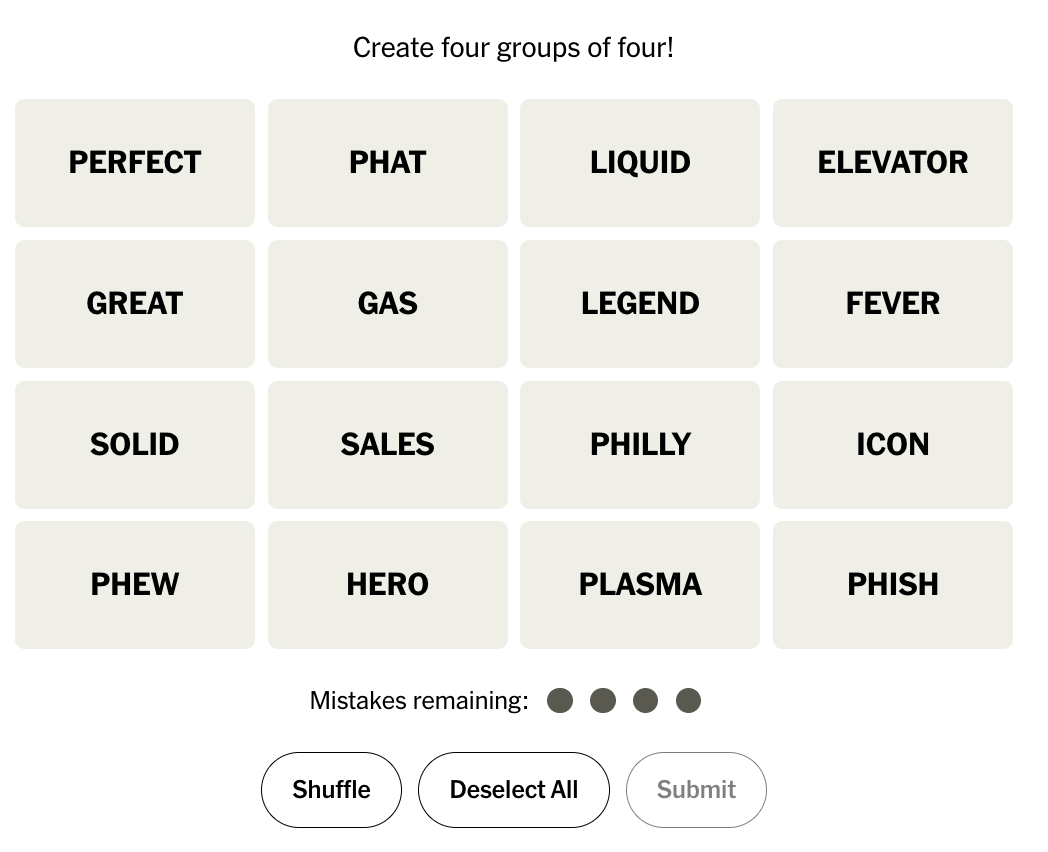
<p>This was my first webdev project, and it was a lot of fun to put together. The code is open source. I welcome any feedback, either at my email address (kylegiddon@gmail.com), on the <a href="https://github.com/khgiddon/chess-stamps">GitHub repo</a>, or through <a href="https://docs.google.com/forms/d/1hFVHN7OuB9u2K8anVJ2WxI6UrDUNsfjl4b-M5UX6kBI/edit">this form</a> (can be anonymous).</p>]]></content><author><name></name></author><summary type="html"><![CDATA[Chess Stamps is a new tool I’ve created for pulling statistics on your chess games played on Lichess. Soon after release, it was featured on the Lichess homepage feed and received over 1,250 unique users in the first week.]]></summary></entry><entry><title type="html">A suggested improvement for the New York Times’s “Connections” interface</title><link href="http://www.kylegiddon.com/connections-ui/" rel="alternate" type="text/html" title="A suggested improvement for the New York Times’s “Connections” interface" /><published>2024-01-11T00:00:00+00:00</published><updated>2024-01-11T00:00:00+00:00</updated><id>http://www.kylegiddon.com/connections-ui</id><content type="html" xml:base="http://www.kylegiddon.com/connections-ui/"><![CDATA[<p><a href="https://www.nytimes.com/games/connections">“Connections”</a> is a new puzzle game released by the New York Times, in which the user assigns items to groups that share something in common, such as “States of Matter” or “<em>__</em> Pitch.” In some cases there are particular examples that may appear to belong to more than one category, but each puzzle only has one unique solution in which all sixteen items are in a group of four.</p>

<p>The fun in the puzzle is sorting out spurious groups from real ones. The problem is that the user interface is wholly unsuited for this—the user can’t do anything except click to assign an item to a group. As I’m going about the puzzle (especially the harder ones), I want to be able to make provisional groups to see if they work in the context of the whole puzzle without submitting them. Because I can’t do this, I have to keep track of the provisional groups in my head, which becomes an entirely different type of challenge from the puzzle itself, more akin to playing <a href="https://en.wikipedia.org/wiki/Blindfold_chess">blindfold chess</a> than logical deduction.</p>

<p>A simple drag-and-drop interface—or “provisional coloring” without forcing submission—would be a huge improvement, and allow for much more difficult, entertaining puzzles while still being fair.</p>

<p><img src="/images/connections.png" alt="New York Times Connections game" /></p>]]></content><author><name></name></author><summary type="html"><![CDATA[“Connections” is a new puzzle game released by the New York Times, in which the user assigns items to groups that share something in common, such as “States of Matter” or “__ Pitch.” In some cases there are particular examples that may appear to belong to more than one category, but each puzzle only has one unique solution in which all sixteen items are in a group of four.]]></summary></entry><entry><title type="html">Joyce’s Ulysses stands alone, or: word uniqueness in some canonical books</title><link href="http://www.kylegiddon.com/book-unique-words/" rel="alternate" type="text/html" title="Joyce’s Ulysses stands alone, or: word uniqueness in some canonical books" /><published>2023-10-22T00:00:00+00:00</published><updated>2023-10-22T00:00:00+00:00</updated><id>http://www.kylegiddon.com/book-unique-words</id><content type="html" xml:base="http://www.kylegiddon.com/book-unique-words/"><![CDATA[<p>While I’m (slowly) writing my own novel, I’ve tried to vary my own reading this year to include authors with different styles for some diversity of inspiration. It’s been a pleasure to flit back and forth between, for instance, Pynchon and DeLillo and Tolstoy. <em>Le style c’est l’homme même,</em> as the French naturalist Buffon said: style is the man himself.</p>

<p>One element of literary style is diction (word choice) and one subelement of diction is the variety of words used, which can be quantified. This is not to say that all elements of diction can be quantified, or that a writer who uses more distinct words is a better writer, but only that quantitative analysis can reveal or confirm elements of a writer’s style.</p>

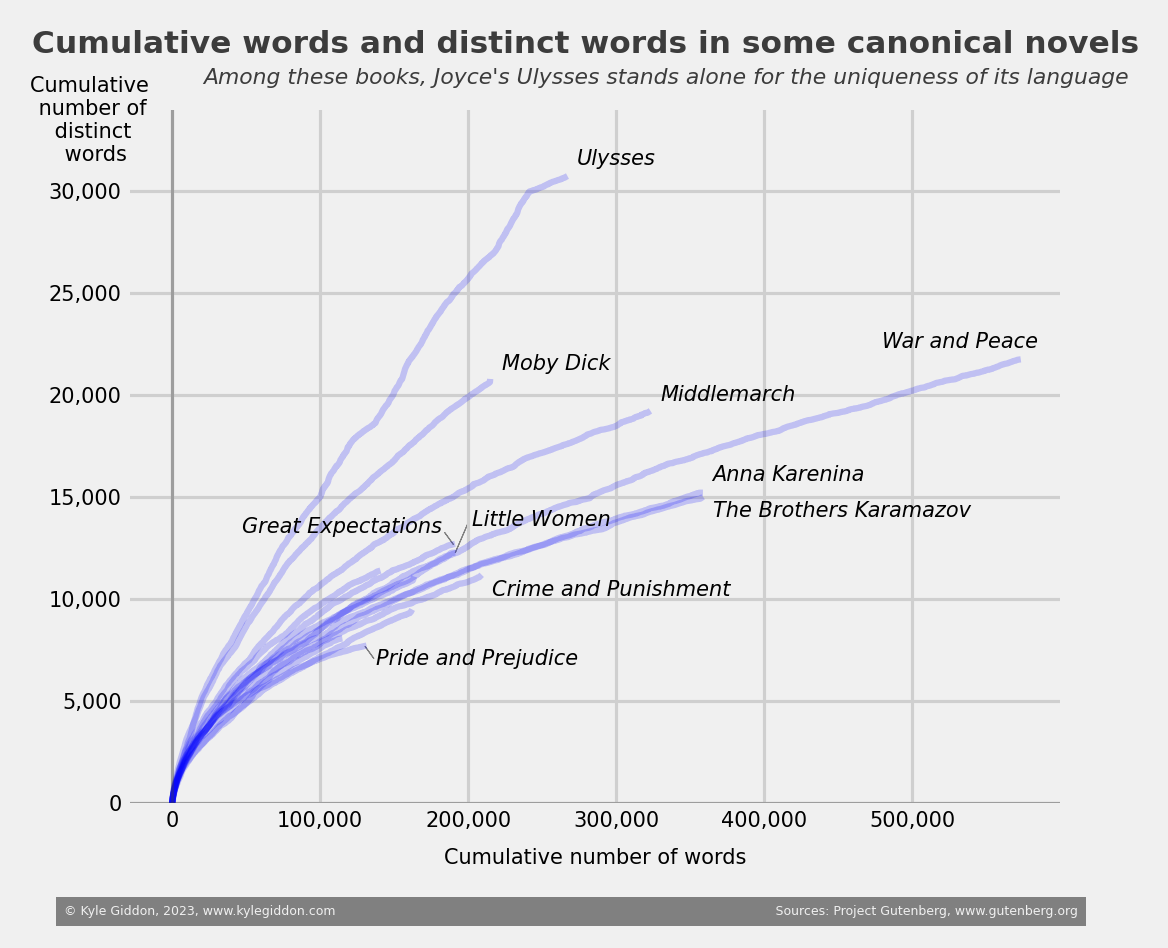
<p>Using the online <a href="https://www.gutenberg.org/">Project Gutenberg library</a>, I’ve analyzed the text of some canonical books in the public domain to look at how the <em>distinct</em> word count grows with the total word count. A distinct word is a word that appears at least once in the text, and the distinct word count is the number of distinct words in the text. The total word count is the number of words in the corpus, including repeated words. I ignore case and punctuation (except hyphens) and a hyphenated word is considered one combined distinct word.</p>

<p>My selection of books was somewhat arbitrary—I looked at the top 100 most downloaded books and filtered to a subset of the list that I considered most renowned, and I wanted to keep the number small enough where individual trajectories could be seen when graphed. (See appendix for the list of books.) It would benefit from a more rigorous implementation in any future extensions.</p>

<p>Results are below.</p>

<p><img src="/images/book_word_count.png" alt="Distinct word count vs. total word count" /></p>

<p>A few observations:</p>

<ol>
  <li><em>Ulysses</em> stands alone in terms of its distinctness—the shape of the function does not resemble any other books of similar length. This is unsurprising and matches the “eye test,” given Joyce’s use of neologisms and portmanteaus, e.g. “psychophysicotherapeutics” and (even better) “scrotumtightening.”</li>
  <li><em>Little Women</em> follows nearly the exact same trajectory of <em>War and Peace</em> up until its end.</li>
  <li>Two of the great Russian novels, <em>The Brothers Karamazov and *Anna Karenina</em>, have nearly identical trajectories.</li>
  <li>A couple authors are represented here twice. Dostoyevsky’s <em>The Brothers Karamazov</em> and <em>Crime and Punishment</em> have similar trajectories, but Tolstoy’s <em>War and Peace</em> has more unique words versus <em>Anna Karenina</em> when comparing similar counts of cumulative words.</li>
</ol>

<h3 id="appendix-code-and-replication-materials">Appendix: Code and replication materials</h3>

<p>Book texts were scraped and analysis was done using Python. The code for this post is available on <a href="https://github.com/khgiddon/misc/tree/main/book_vocabulary/web_test">GitHub</a>.</p>

<p>The books represented in the graph are:</p>

<ul>
  <li>Adventures of Huckleberry Finn by Mark Twain</li>
  <li>Anna Karenina by Leo Tolstoy</li>
  <li>Crime and Punishment by Fyodor Dostoevsky</li>
  <li>Dracula by Bram Stoker</li>
  <li>Emma by Jane Austen</li>
  <li>Great Expectations by Charles Dickens</li>
  <li>Little Women by Louisa May Alcott</li>
  <li>Middlemarch by George Eliot</li>
  <li>Moby Dick; Or, The Whale by Herman Melville</li>
  <li>Pride and Prejudice by Jane Austen</li>
  <li>The Brothers Karamazov by Fyodor Dostoevsky</li>
  <li>A Tale of Two Cities by Charles Dickens</li>
  <li>Ulysses by James Joyce</li>
  <li>War and Peace by Leo Tolstoy</li>
</ul>]]></content><author><name></name></author><summary type="html"><![CDATA[While I’m (slowly) writing my own novel, I’ve tried to vary my own reading this year to include authors with different styles for some diversity of inspiration. It’s been a pleasure to flit back and forth between, for instance, Pynchon and DeLillo and Tolstoy. Le style c’est l’homme même, as the French naturalist Buffon said: style is the man himself.]]></summary></entry><entry><title type="html">It is a near certainty that multiple people have died while listening to Bill Simmons</title><link href="http://www.kylegiddon.com/bill-simmons-death-probability/" rel="alternate" type="text/html" title="It is a near certainty that multiple people have died while listening to Bill Simmons" /><published>2023-10-21T00:00:00+00:00</published><updated>2023-10-21T00:00:00+00:00</updated><id>http://www.kylegiddon.com/bill-simmons-death-probability</id><content type="html" xml:base="http://www.kylegiddon.com/bill-simmons-death-probability/"><![CDATA[<p>Over on Reddit, <a href="https://www.reddit.com/r/billsimmons/comments/17cvzm0/has_anyone_died_listening_to_the_bs_pod/">someone asked</a> whether anyone has ever died while listening to podcaster Bill Simmons. It would be an undignified way to go: having the last thing in one’s head be one of Bill’s nuclear-level takes on sports or pop culture like saying that <a href="https://twitter.com/carternixon/status/1229872026602496001">Robert Forster isn’t good in <em>Jackie Brown</em></a>. Ugh. (Robert Forster is great in <em>Jackie Brown</em>.)</p>

<p>I do frequently listen to Bill Simmons’s podcasts, and I thought the question was worthy of a more formal approach, both for the sake of scientific inquiry and also as a <em>memento mori</em>-esque caution. Below we explore the question: What is the probability that <em>at least one person</em> has died while listening to Bill Simmons?</p>

<p>The title does give away the result: it is a near certainty that not only one but multiple people have died while listening to Bill. Let’s go through it.</p>

<h3 id="the-death-model">The death model</h3>

<p>We first describe the general mathematical model we’ll be filling out, which will require a series of assumptions. The goal of these assumptions is to balance the complexity of the model with the precision of the model, and overall we’ll be looking for a ballpark figure.</p>

<p>First, we want to model the probability of death while listening to Simmons for <em>a given listener of the podcast</em>, in a given year. Then we will take a cohort approach later and look at all listeners of the podcast  over time.</p>

<p>Let us first consider probability of death. Probabilities of death given age and gender are available from the <a href="https://www.ssa.gov/oact/STATS/table4c6.html">Social Security Administration</a>, and we’ll rely on those actuarial tables. For example, for a 33-year-old male the annual death probability is 0.002517, and for a 70-year-old male it is 0.026137.</p>

<ul>
  <li>Assumption: Our model is yearly. We’ll assume that the probability of death is constant over the course of a year.</li>
  <li>Assumption: All listeners are American. While this isn’t true, this enables us to use the SSA actuarial tables.</li>
  <li>Assumption: Listeners of the podcast are representative of their age cohort in terms of their health.</li>
  <li>Assumption: The probability of death while listening to the podcast is independent of the overall probability of death. That is, we assume that listening to the podcast does not affect the probability of death for a given listener. Perhaps this isn’t quite true, because listeners may be listening to the podcast while driving where death probability is higher vs. staying at home, or one of Bill’s takes may be so bad that it causes a listener to just keel over and end it all. Or you could think that for those on their deathbed, they might finally put down their headphones and be less likely to be listening. But we’ll go with the assumption of independence.</li>
</ul>

<p>We need to make some assumptions about listener ages and genders in order to use the actuarial tables. I could not find good statistics about this online, so we’ll make the following assumptions:</p>

<ul>
  <li>Assumption: Bill’s listeners’ ages follow a uniform distribution between age 18 and age 75. That is, the probability of a listener being age \(x\) is \(P_{\text{Age}}(x) = \frac{1}{75 - 18}\).</li>
  <li>Assumption: Bill’s listeners are 100% male. I know this isn’t true in practice but it’s close enough, and this won’t be a significant source of error in the model.</li>
</ul>

<p>Now we need to determine the percentage of time in a given year that the average listener spends listening to the podcast. A listener is defined as someone who downloads and listens to the podcast at least once a year. This is important for our model later: a listener is not the listener of a <em>given</em> episode, but someone who listens to the podcast at least once in a year (because we need to be able to join this with statistics on someone’s death probability in a given year).</p>

<p>For each listener, we want to find the percentage of the time they are listening to Bill Simmons. This can be modeled as the total number of annual podcast minutes released by Simmons, multiplied by the percentage of these minutes listened to by the average listener, all divided by the total number of minutes in a year.</p>

<ul>
  <li>Assumption: The relationship between how often a given listener listens to the podcast and death probability is independent. That is, more frequent listeners are not more likely to die on a rate basis. This enables to use averages and simplify the model.</li>
  <li>Assumption: Time spent listening is independent of listener age. That is, older listeners are not more likely to listen to the podcast more often than younger listeners.</li>
</ul>

<p>We also must decide whether we care about dying while Bill himself is speaking, or whether dying while one of his guests or cohosts is speaking also counts. I believe the spirit of the original question is about Bill Simmons himself, so we’ll go with that.</p>

<p>The percentage of time in a year that a user spends listening to the podcast requires the following assumptions:</p>

<ul>
  <li>Assumption: Simmons releases a podcast 2–3 times per week, or 12 times per month / 144 times per year, including the <em>Bill Simmons Podcast</em> and its previous iterations and as a host on <em>The Rewatchables</em> podcast.</li>
  <li>Assumption: The average length of these podcasts is 93 minutes—this assumption is based on the measured length of the ten month-to-date October episodes. (This length is true recently but might not be true for early iterations of the podcast like the <em>BS Report</em>, but we’ll go with it throughout time. Measuring  the October lengths only also doesn’t take into account any variation in average episode lengths due to seasonality.) We’ll also ignore the length of ad reads (which on Spotify aren’t typically included in the episode lengths), even though it is Simmons usually speaking during the ad reads. The thought of dying while listening to Bill read an ad for SimpliSafe is too depressing to pursue further. We’ll also ignore Bill’s cancelled <a href="https://youtube.com/watch?v=y1dGNbtHdV8&amp;ab_channel=HBO">HBO show</a>, because I don’t know in that case if we can safely assume that listening and death are independent.</li>
  <li>Assumption: The average listener listens to 5% of total minutes of each podcast. This is a crticial assumption. But remember we’re dealing with an <em>average</em> here of anyone who downloads and listens to the podcast over a year, including counting listeners who might only listen for a few minutes a year. If this seems low, it’s because we’re lumping in power-listeners with casual listeners.</li>
  <li>Assumption: Across all these podcasts, Bill is speaking 75% of the time. This is a guess. One could scrape all the episode transcripts and generate statistics about word count to get more scientific about this in particular.</li>
</ul>

<p>Therefore the percent of time spent listening to Bill is:</p>

\[\displaylines{\tag{1} \text{Time spent listening to Bill Simmons} = \\ \text{Simmons podcasts per year} \\ \times \text{Length of each podcast (in minutes)} \\ \times \text{Episode completion pct} \\ \times \text{Pct of time Bill is speaking}}\]

<p>Now we can input the values using our assumptions above, and we divide by the total number of minutes per year to get the percentage of time spent listening to Bill Simmons:</p>

\[\tag{2} \text{Pct of time spent listening to Bill Simmons} = \frac{144 \times 93 \times 0.05 \times 0.75}{525,600} = 0.096\%\]

<p>Or, the average listener for a given year spends 0.096% of their time listening to Bill Simmons.</p>

<p>Now, for a given listener, the probability of death while listening to Bill Simmons is:</p>

\[\tag{3} P(BD)_{\text{y}} = P(D)_{\text{age, gender}} \times BR\]

<p>Where:</p>

<ul>
  <li>\(P(BD)_{\text{y}}\) is the probability of death while listening to Bill Simmons (“Bill Death”) in a given year <em>y</em></li>
  <li>\(P(D)_{\text{y}}\) is the probability of any death, conditional on the listener’s age and gender</li>
  <li>\(BR\) is the “Bill Ratio,” or the % of time spent listening to Bill Simmons. From equation (2) we know this is 0.096%.</li>
</ul>

<p>Now we can calculate the probability of death while listening to Bill Simmons for a given listener in a given year. We need to extend this out over time for all of Bill’s listeners since he first started podcasting.</p>

<h3 id="number-of-annual-listeners">Number of annual listeners</h3>

<p>Bill first launched the <em>BS Report</em> podcast in <a href="https://en.wikipedia.org/wiki/Bill_Simmons#:~:text=On%20May%208%2C%202007%2C%20Simmons,song%20written%20by%20Ronald%20Jenkees.">May 2007</a> (under the name <em>Eye of the Sportsguy</em>). We’ll model out 16 years of podcasts (15 full years from 2008–2022 and one year combining the 2007 and 2023 partial years.)</p>

<p>How many listeners does Bill have? 
In 2009, the podcast was <a href="http://www.espnmediazone3.com/us/2010/01/another-record-year-for-espn-digital-media/">downloaded over 25 million times</a>, and has likely grown in popularity since then. According to Edison Research, <em>The Bill Simmons Podcast</em> is currently <a href="https://www.edisonresearch.com/weekly-insights-2-15-23-listening-makes-for-better-watching-the-top-sports-podcasts-revealed/">the most-downloaded sports podcast in the world</a>. The Reddit braintrust seems to think that Bill could get between <a href="https://www.reddit.com/r/billsimmons/comments/14h6oey/how_many_people_listen_to_bills_podcast_on_average/">500,00 and 1 million downloads per episode</a> (which is not the same as listeners), which would bring the total number of annual downloads north of 100 million.</p>

<p>But for our model we’re looking for the number of yearly listeners (who download at least one episode), not the number of listeners per episode. Data on this is difficult to come by. We’re going to assume 2 million annual unique listeners (some of who might only listen to one episode), meaning that each episode is downloaded by somewhere betwen 25% and 50% of annual unique listeners.</p>

<p>We could model the number of listeners per year differently for each year, but since Bill’s podcast became popular very quickly after launching, we’ll say:</p>

<ul>
  <li>Assumption: Bill’s podcasts have had 2 million unique listeners per years since 2007.</li>
</ul>

<p>We could model this number separately by year to account for Bill’s growing popularity (e.g., as a linear function), but in the absence of concrete data about this year, we’ll use one constant number per year.</p>

<h3 id="the-final-model">The final model</h3>

<p>Now we can put all the pieces together.</p>

<p>If the probability of death while listening to Bill Simmons for a given listener <em>l</em> in a given year <em>y</em> is \(P(BD)_{\text{y}}\), then the probability of at least one death for two listeners in a given year is:</p>

\[\tag{4} P(\text{At least one death})_{\text{y}} = 1 - (1 - P(BD)_{\text{y,}l_1}) \times (1 - P(BD)_{\text{y,}l_2})\]

<p>Then for all listeners <em>l</em> in a given year, the equation will be:</p>

\[\tag{5} P(\text{At least one death})_{\text{y}} = 1 - \prod_{l=1}^{n_{y}
} (1 - P(BD)_{\text{y,}l})\]

<p>Substituting in equation (3) for \(P(BD)_{\text{y,}l}\), we get:</p>

\[\tag{6} P(\text{At least one death})_{\text{y}} = 1 - \prod_{l=1}^{n_{y}} \left(1 - P(D)_{\text{age}_{l}, \text{gender}_{l}} \times BR \right)\]

<p>To find a solution to the equation above using the actuarial tables provided by the Social Security Administration, we’ll write a script in Python. The script is available <a href="https://github.com/khgiddon/misc/blob/main/simmons/solve.ipynb">here</a>.</p>

<p>After running this script, we find that <em>the probability of at least one death while listening to Bill Simmons is nearly 100%</em>, just in one given year. So not only is it a near certainty that someone has died while listening to Bill Simmons, but it’s likely that someone has died while listening to Bill Simmons every single year.</p>

<p>Just a sensitivity check, in case one of our assumptions are off: if we assume that one of our assumptions is off by a factor of ten and we appropriately divide the death probability by 10, this still leaves an 82% probability of at least one death in a given year.</p>

<p>If we use 82% as the annual probability, we can ask for the probability of at least one death over the course of 16 years. All of our assumptions are constant by year, we can simply use the following equation to find the probability of at least one death listening to Bill during his podcasting tenure:</p>

\[\tag{7} P(\text{At least one death})_{\text{16 years}} = 1 - (1 - P(\text{At least one death})_{\text{y}})^{16} \approx 100\%\]

<p>Based on the earlier analysis, it seems to safe to say that multiple people have indeed heard Bill in their last moments on this Earth.</p>]]></content><author><name></name></author><summary type="html"><![CDATA[Over on Reddit, someone asked whether anyone has ever died while listening to podcaster Bill Simmons. It would be an undignified way to go: having the last thing in one’s head be one of Bill’s nuclear-level takes on sports or pop culture like saying that Robert Forster isn’t good in Jackie Brown. Ugh. (Robert Forster is great in Jackie Brown.)]]></summary></entry></feed>